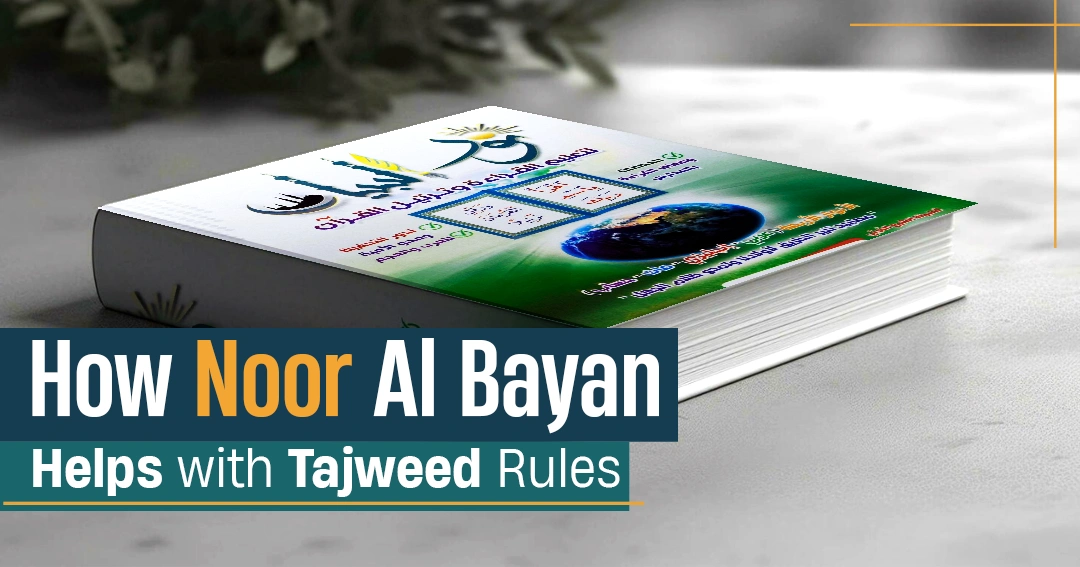
Noor Al Bayan and Tajweed are a strong duo when it comes to becoming proficient in the art of reading and reciting the Quran perfectly.
Noor Al Bayan helps students master the Arabic letters and sounds step by step, while Tajweed makes each word sound correctly. Together, they provide a strong starting point for anybody—child or adult—who desires to connect spiritually with the Quran.
Whether a beginner or enhancing your child’s recitation, this method makes learning the Quran simple, comprehensible, and spiritually satisfying.
What is Noor Al Bayan?
Noor Al Bayan is a widely praised learning method to teach children and beginners how to read the Quran correctly in Arabic.
Noor Al Bayan and Tajweed is focused on the teaching of the Arabic alphabet, reading, and letter connecting to build words. Learners are guided step by step until they can read Quran verses correctly and smoothly.
The beauty of Noor Al Bayan and Tajweed is simplicity with effectiveness. Not only does it teach how to read, it establishes a strong foundation that will lead one to understand and apply Tajweed rules, which is a prerequisite to perfect recitation of the Quran.
The Connection Between Noor Al Bayan and Tajweed
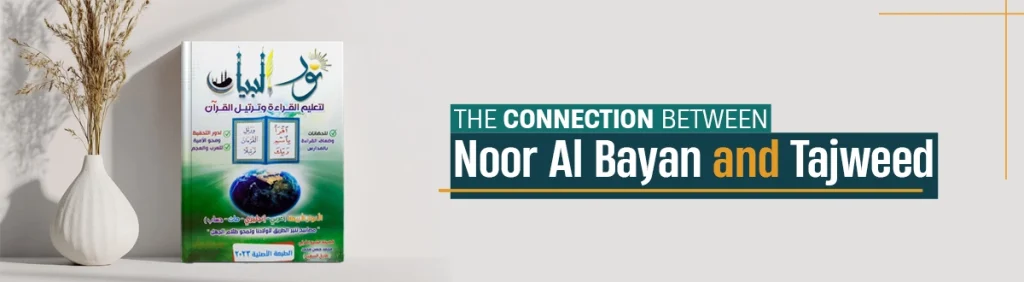
Noor Al Bayan is the first step towards learning Tajweed. Noor Al Bayan lays down the foundation by educating you how to read letters and words in Arabic. It is similar to learning the alphabet first before one learns to read full sentences of a foreign language.
Noor Al Bayan and Tajweed instructs you on how each letter is pronounced, how to join them properly, and how to read them from their correct positions within the mouth and throat (Makharij).
That is exactly what Tajweed is all about: reading the Quran with the right rules and pronunciation.
Key Tajweed Rules Taught Through Noor Al Bayan
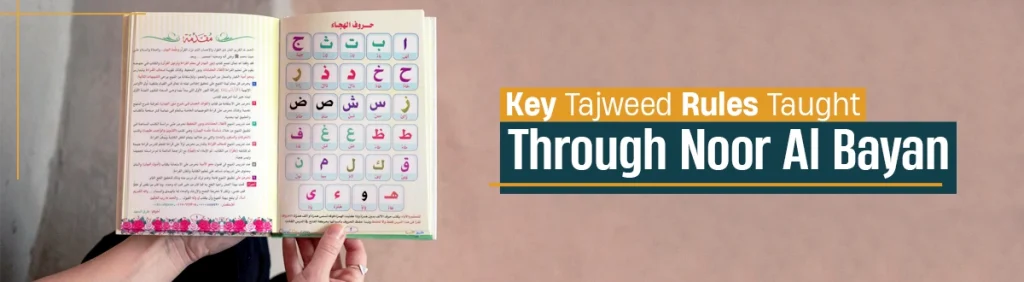
If you’ve ever wondered how people learn to recite the Quran so beautifully, the answer often starts with a combination of Noor Al Bayan and Tajweed. These two work together to teach not just reading but proper recitation, just like the Prophet Muhammad ﷺ recited the Quran.
Noor Al Bayan explains the rules of Tajweed easily and step by step so that beginners are not overwhelmed. Let us see some of the most significant Tajweed rules that the students begin to learn through Noor Al Bayan:
1. Makharij Al-Huruf (Articulation Points of Letters)
One of the very first things Noor Al Bayan and Tajweed teaches is how to pronounce each letter of Arabic from its proper place in the mouth or throat.
For example, the letter “ع” (‘Ayn) comes from the middle of the throat, and “ب” (Ba) comes from the lips. This is a fundamental Tajweed rule, without it, words will be incorrectly pronounced.
2. Sifaat Al-Huruf (Characteristics of Letters)
Once students are familiar with the sounds, they start identifying the natural nature of letters, like whether a sound is to be heavy or light. Noor Al Bayan and Tajweed simply describe this, especially for kids.
3. Harakat and Tanween (Short Vowels and Double Vowels)
Noor Al Bayan and Tajweed teaches Fatha, Kasra, Dammah and how they function to alter the letters’ sounds. It also instructs Tanween (Nunation), another essential part of Tajweed, when reading Quran verses correctly.
4. Sukoon and Shaddah (Stillness and Stressing Letters)
The awareness of when to suspend a letter on (Sukoon) or stress one (Shaddah) is essential in Tajweed. Noor Al Bayan and Tajweed teaches students these rules using sufficient practice and repetition, such that the learners apply them instinctively.
5. Madd (Prolongation Rules)
The Madd rules (lengthening sounds) are also introduced slowly. This is one of the most beautiful things about Tajweed: learning how and when to lengthen a sound when reading. It adds rhythm and smoothness to reciting the Quran.
What is the difference between Noor Al Bayan and Noorani Qaida?
Here is a comparison between Noor Al Bayan and Noorani Qaida:
| Feature | Noor Al Bayan | Noorani Qaida |
| Origin | Developed by Sheikh Tarek Al-Saeed (Egypt) | Developed in the Indian subcontinent |
| Approach | Modern, phonetic-based approach | Traditional method |
| Focus | Strong emphasis on Makharij and Tajweed from the start | Focuses on Arabic letters, vowel marks, and word building |
| Structure | Step-by-step and visually clear | Slightly older format, may vary by publisher |
| Tajweed Integration | Integrated throughout lessons | Introduced later or separately |
| Ease for Non-Arabic Speakers | Very beginner-friendly, especially for kids & adults | Effective, but sometimes challenging for beginners |
| Preferred By | Modern Quran teachers and academies like Tareequl Jannah Academy | Traditional madrasas, especially in South Asia |
| Best For | Learners aiming to master Noor Al Bayan and Tajweed together | Those following a more traditional curriculum |
Step-by-Step Learning Approach
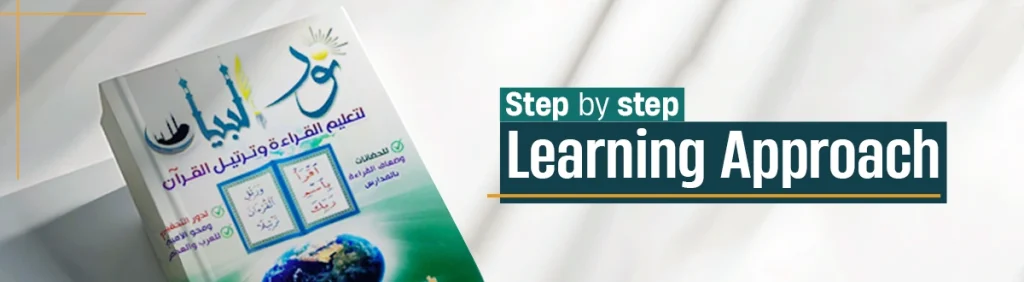
By combining Noor Al Bayan and Tajweed in a well-structured, gradual way, you’re establishing the perfect groundwork for a lifetime of recitation of the Quran.
Step 1: Learning the Arabic Alphabet
The learning starts with the identification and pronunciation of the 28 letters of Arabic from Alif to Yaa. They are taught how to pronounce each letter correctly, emphasizing its appropriate Makharij (Articulation point), which is an integral aspect of Tajweed.
This step is all about listening, imitation, and becoming accustomed to sounds.
Step 2: Letter Shapes and Positions
Arabic letters also come in different forms depending on where they appear within a word (initial, medial, final). Noor Al Bayan and Tajweed teaches how to identify and read such differences. This makes the students confident in reading complete words afterwards.
Step 3: Adding Harakat (Short Vowels)
After the letters are memorized, then comes learning Fatha ( َ ), Kasra ( ِ ), and Dammah ( ُ ). These short vowels give letters sound and are essential for correct reading.
This is where Noor Al Bayan and Tajweed start to blend. Correct pronunciation of vowels is the start of fluent Quranic recitation.
Step 4: Practicing Sukoon and Shaddah
Students are then taught:
Sukoon ( ْ ) — for stationary letters
Shaddah ( ّ ) — for stressed or doubled letters
These are crucial to reading the Quran properly, and Noor Al Bayan makes them easy with step-by-step examples.
Step 5: Reading Small Words and Phrases
Here, students start reading short words by combining letters and vowels. They practice fluency, rhythm, and accuracy, gaining the confidence to finally read full verses.
Step 6: Introduction to Tajweed Rules
Once the student is comfortable reading, Tajweed is introduced in a step-by-step manner. Basic rules like Ikhfa, Idgham, and Madd are learned in context by practice, thus making the learning process natural and easy.
The Prophet Muhammad ﷺ said:
“Make the Qur’an beautiful with your voices.” (Sunan Abi Dawood 1468)
This hadith encourages us to read the Quran with care, which becomes second nature when Noor Al Bayan and Tajweed are studied from the very start.
Conclusion
Learning Noor Al Bayan and Tajweed with the right method can transform a struggling learner into a confident reciter, and Tareequl Jannah Academy is here to help every step of the way.