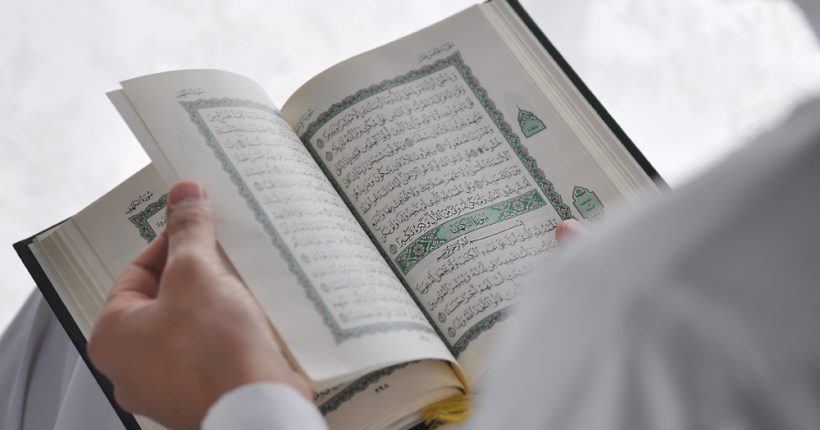
You open a Quran for the first time. The letters are foreign, the script runs right to left, and then you notice them: tiny marks scattered above and below every letter, some like small diagonal lines, others like miniature hooks. Nobody told you about these.
Your lesson last week was on the alphabets, but after the lessons, the whole concept seems to have changed completely. The difference between learning letters and reading the Quranic text lies here. Most people tend to give up here not due to the complexity of the language but due to lack of knowledge about these markings.
They are not decorations. They are not optional. Every single one of those small marks — the ones above the letters, the ones below, the little hook-shaped ones, is carrying sound. You will be seeing a skeleton consisting of only consonants without knowing how to pronounce these words. The three which will become more common in all of the Quran are fatha, kasra, and damma, and these correspond to the three short vowels that make the Arabic language unique in pronunciation.
This article will provide you with all the basics about fatha, kasra, and damma: their form, position on the letter, pronunciation of each one, significance to meaning within the Quran, and why making mistakes between these sounds should be avoided by any professional reciter.
What the Quran Would Look Like Without Them
Before getting into each mark individually, it helps to understand why these marks exist in the Quran at all, since standard Arabic writing, the kind you see on street signs, newspapers, and social media, almost never uses them.
The basic principle of writing in Arabic is the writing of consonants alone. The native speakers supply the vowels from memory or context because their life has been spent listening to the language. This is comparable to an English-speaking person reading the abbreviation “bldg” and interpreting it as “building.” The brain completes it automatically.
Non-native speakers don’t have that store of intuition. And neither did the many new Muslims who entered the faith in the early centuries of Islam from Persia, Africa, and beyond. Historical records indicate that as non-Arab communities began reciting the Quran, pronunciation errors became a documented concern. In this way, these scholars formulated an authorized notation of diacritical marks known as harakat, which in Arabic means “movements”, that had been used solely to ensure accurate pronunciation of the Qur’anic text. The inventor of the first system of harakat was Abu al-Aswad al-Du’ali, and he was succeeded in this work by al-Khalil ibn Ahmad al-Farahidi.
It should be noted that the Quran is among very few texts in Arabic where every letter is accompanied by either haraka or sukoon (indicating absence of a vowel).That is also what makes it the ideal text for non-Arab learners to start with, it tells you, precisely, exactly how every word should sound.
Fatha: The Mark Above the Letter
Shape and Position
Fatha (فَتْحَة) is like a small diagonal line written up above the letter, yeah. It’s basically a little stroke , above the character. If you look at the Arabic word for “he wrote” — كَتَبَ (kataba) — you’ll notice three letters, and on top of each one there’s a fatha. That mark above each letter, tells you to make an “a” sound right after the consonant.
Now the word fatha comes from an Arabic root meaning “opening,” and I think that’s handy, because when you pronounce it you kind of open your mouth verticallyThink of the “a” in “cat” or in “back.” The sound sits roughly in that area, though it can shift a tiny bit depending on which letter it’s attached to, so the flavor changes slightly.
Its Occurrence in the Quran
Amongst the other two vowels, fatha is the most used mark in the Quran. Part of the reason is that most Arabic verb patterns are built on forms that include fathas. So when you read Surah Al-Fatiha, and you come across the phrase “الحَمْدُ لِلَّهِ”, the fatha sitting above “حَمْ” is what drives the “ha” sound. Also, the fatha doesn’t really sit alone like it’s separate. It’s placed right above the letter and then becomes part of the overall sound you say.
One thing beginners often miss is that fatha can show up in an extended form called the standing fatha (فتحة قائمة). It looks more like a small vertical alif type mark, rather than the diagonal one. This standing fatha tells you there’s a longer “aa” sound, stretched across two beats. You see it a lot in Quranic words like الرَّحْمَٰنِ (ar-Rahman), where that longer mark clearly indicates the long vowel.
Kasra: The Mark Below the Letter
Shape and Position
Kasra (كَسْرَة) is the same diagonal stroke as fatha, but placed below the letter rather than above. Its name derives from the Arabic root for “breaking” or “lowering,” which maps well to how it is produced: the jaw drops slightly, and the middle of the tongue rises toward the roof of the mouth, producing a short “i” sound, like the “i” in “bit” or the “ee” in “bee” (held briefly, not drawn out).
Take the word كِتَاب (kitab), meaning “book.” The kasra under the first letter — the kaf — tells you this syllable begins with a “ki” sound, not “ka” or “ku.” Change that one mark and you change the word.
How It Appears in the Quran
Kasra appears frequently under letters that carry grammatical markers indicating possession or prepositional relationships. This is the reason why the notation is crucial not only in terms of pronunciation but also in Classical Arabic where the annotation of the last letter of the noun would determine its role in the sentence. The nouns whose last letter ends with kasra generally belong to the genitive case and this indicates that it follows the preposition or expresses possession.
The grammatical perspective is less relevant to the non-native speaker compared to the pronunciation perspective.That is why what becomes crucial initially is the fact that seeing such a mark below the letter will make you pronounce the vowel sound “i,” and you should not stretch it into “ee” unless there is another mark for a long vowel after it.
Damma: The Hook Above the Letter
Shape and Position
Damma (ضَمَّة) looks different from the other two. Where fatha and kasra are strokes, damma is a small hook or curl that resembles a miniature version of the Arabic letter waw (و). It sits above the letter, and it tells you to round your lips and push them slightly forward to produce a short “u” sound, like the “u” in “put” or the “oo” in “book” (again, held short, not drawn out).
The word damma comes from a root meaning “to join” or “to bring together,” and that joining of the lips is exactly the physical action involved. If your lips are not rounded and slightly forward when you produce a damma, the sound will slide toward a fatha or something in between.
How It Appears in the Quran
Damma frequently marks the nominative case in Arabic, nouns that function as the subject of a sentence. This gives damma an important grammatical role in Quranic text that experienced readers recognize at a glance. However, for a beginner, the important point is that the damma makes an audible sound different from the sounds of fatha and kasra; and the Quran makes sure that each specific sound occurs in a specific place.
Here is a good illustration from the beginning verse of Surah Al-Ikhlas: قُلْ هُوَ اللَّهُ أَحَدٌ (Qul huwa Allahu Ahad). The word هُوَ (huwa, meaning “He”) has a damma on its first letter and hence sounds like “hu.” The word أَحَدٌ (Ahad, meaning “One”) has fatha on its first letter. Both marks appear in the same short verse. Reading without awareness of the distinction produces a sound that is, at minimum, imprecise, and imprecision in Quranic recitation is something students of Tajweed work seriously to correct.
Why Getting These Wrong Changes More Than Pronunciation
There is a well-known account in Islamic scholarship about the moment that motivated early scholars to introduce vowel marking in the Quran. A reader misread a verse, altering a short vowel in a way that changed who was being described, shifting a quality from Allah to His Prophet in a sentence where the grammar depended on a single mark. Whether or not this story appears to you in any of its many versions from Islamic writings, the essence of what it conveys is true: in Arabic, one tiny symbol makes the difference between meaning and meaninglessness.
The Arabic word مَلَك (malak), which carries two fathas, translates into English as “angel.” Remove the second fat-ha and add a kasra, and the word now becomes مَلِك (malik), translating to “king.” Only the marks tell them apart.
This is not an obscure edge case. It repeats throughout the Quran, which is precisely why the text is fully vowelled. The marks are not there because Arabic is difficult, they are there because these words matter too much to leave ambiguous.
Acquiring the Skill in Practical Application
When students sit down with the Quran trying to figure out fatha, kasra, and damma independently, they invariably face identical challenges. They are able to distinguish each mark individually but lack the ability to do so in combination when applied to unknown letters. The skill transfers from recognition to fluency only through consistent, corrected practice.
A few things are worth knowing as you build this:
The order of difficulty is not what most beginners expect. Fatha tends to come most naturally because the mouth shape is closest to neutral. Damma is often the hardest to maintain correctly, because lip rounding takes more conscious control, and many non-Arab learners unconsciously produce something closer to “o” or to fatha instead of a clean “u.” Kasra is somewhere in the middle.
Common mistakes include treating all three marks as approximately the same sound and relying on context to guess the rest. This produces recitation that may be broadly intelligible but is not accurate at the level the Quran demands.
Frequently Asked Questions
Q: What is the difference between fatha, kasra, and damma in terms of where they are placed?
Fatha is placed above the letter and produces a short “a” sound. Kasra is placed below the letter and produces a short “i” sound. Damma is placed above the letter, like fatha — but it looks different, resembling a small hook or curl rather than a diagonal stroke, and produces a short “u” sound. The position of kasra below the letter is the easiest way to distinguish it instantly from the other two.
Q: Are fatha, kasra, and damma used in Arabic writing on a regular basis?
No, not normally. Fatha, kasra, and damma are almost never used in modern day Arabic writings, such as in newspapers, emails, or even websites, since Arabic natives do not require their use. The only place that They can be found consistently in the Quran.
Q: Will a mistake in fatha, kasra, or damma alter the meaning of a verse in the Quran?
Absolutely, and this isn’t something hypothetical. The nature of the Arabic language is such that its words can mean completely different things based on what harakat are added to a set of consonants. A mistake in even one haraka might transform a noun into another, a verb into another tense, and create an entirely new word out of thin air.
Q: How long does it take to feel confident about using fatha, kasra, and damma while reading Quran?
It depends greatly on the individual. Some learners can identify and produce all three marks distinctly within a few weeks of daily practice. Others take months before the recognition becomes automatic during actual recitation rather than only during isolated exercises. The speed depends on how much listening is combined with reading, hearing a qualified reciter while following the text tends to accelerate progress more than reading silently alone.
Q: Is it necessary to learn grammar to understand these marks in the Quran?
Not at the beginning. The grammatical functions of fatha, kasra, and damma (marking case endings on nouns, for example) are a layer that Arabic students encounter later when studying formal grammar. For the purpose of recitation, what matters first is producing the correct sound for each mark, consistently and clearly. Grammar understanding comes in time and deepens comprehension, but it is not a prerequisite for learning to read the Quran aloud correctly.
Conclusion
Understanding fatha, kasra, and damma intellectually is not the hard part. Most learners can grasp the three shapes, the three positions, and the three sounds in a single sitting. What takes time is the calibration, the work of making the body produce those sounds reliably, hearing when it goes wrong, adjusting, and doing it again across thousands of words.
That calibration is not something that happens through reading about the marks. It happens through practice with someone who can hear the difference and tell you when the distinction between your damma and your fatha has started to blur. It happens through listening to Quranic recitation while following the text, so that your ear and your eye develop simultaneously. And it happens gradually, across time, in a way that is not always visible session by session but becomes obvious over months.
The marks themselves are a beginning. What they open access to is the rest of the text.
If you’re working through the basics of Arabic letters and vowel sounds and want structured guidance from native speakers, Arabic for Beginners Course at Tareequl Jannah covers exactly this foundation. Start today.